
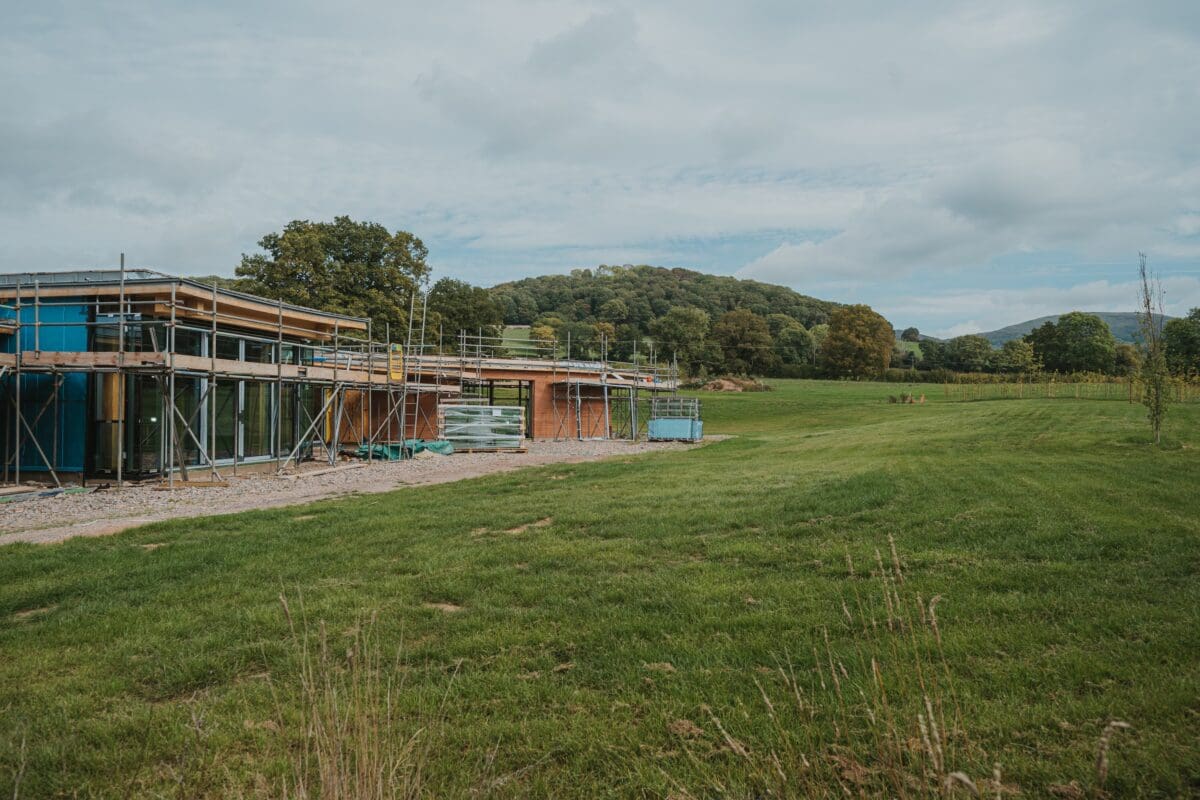
A few weeks ago, we held an open day at our Earth House project to share some of our excitement about this unique build and the extraordinary people working on it.
One of the people we invited was Catherine Every, who’s written many of our project stories and articles over the years. We asked her to share her thoughts on the day – here’s what she had to say.
Writing about a Communion Architects project always gives me a glimpse into the extraordinary thought and care that goes into one of their projects.
Seeing projects in real life, especially when they’re still being constructed, gives me a deeper level of understanding of the thought, care and commitment that’s involved in bringing a building to life.
As I reflected on my visit to the Earth House, three themes emerged.
Responsibility and respect
The Earth House sits in beautiful countryside and looks out over the Malvern Hills. Securing permission to build in such a setting is no easy feat. The National Planning Policy Framework says permission for isolated homes in the countryside should only be granted in a few circumstances, one of which is that the design must be of exceptional quality.
Creating a house of exceptional quality is a daunting brief when you think about it. It’s an incredible responsibility to formulate a design that will satisfy the needs of the client and the planning authority – and respect the landscape it will take its place in.
In this case, the key was to build a house from the materials in the surrounding landscape.
To further acknowledge and respect the landscape, there will be a living roof that means the house will blend into its surroundings from afar, never detracting from or interrupting the beauty people experience when they walk the Malvern Hills.
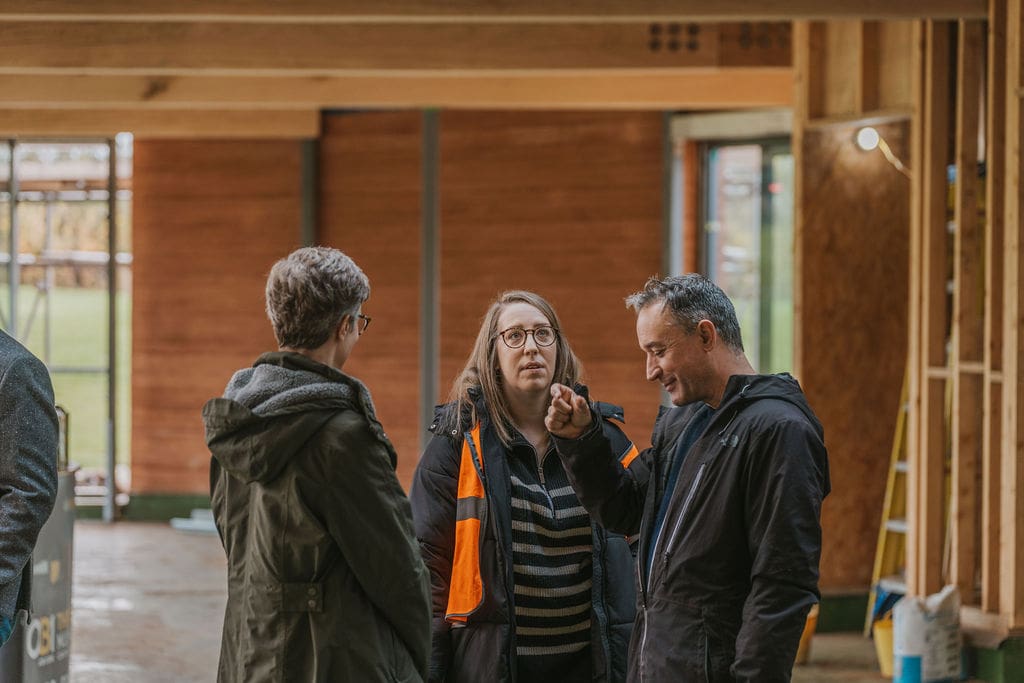
From left to right: Catherine Every from Every Word, Stef Harris from CBG Light Perceptions and Alex Coppock from Communion Architects
Excellence and expertise
I think we’re all familiar with the professionals who are involved in constructing a house – builders, electricians, plumbers, landscapers and so on. I know I don’t consider often enough the people who are involved with designing each of these elements in the first place. Alongside the architect, a house design may involve lighting designers, landscape architects, kitchen designers and more.
It was wonderful to meet a few of these people at the Earth House. Even more wonderful was to understand more about their extraordinary knowledge of their subject and their attention to detail. For example, the lights set into the floor will wash the rammed-earth walls with light, subtly illuminating the unique finish. Outside, great care has gone into designing a landscape that will enhance the views from the house, and also the experience of the walkers who will use the public footpath that runs through the property.
It was humbling to see how much thought goes into elements that could so easily go unnoticed, but which are essential in a building of exceptional quality.

Craftsmanship and community
Of course, the Earth House gets its name from the rammed earth walls that are one of its principal features.
As we explain in Building Closer to Home, it’s an ancient technique that’s rarely used in this country any longer. What this means in practice is there are no instruction manuals.
Creating a material with the structural integrity required was therefore a case of trial and error on the part of Nick McHale of King N Construction, the builder on the project. As he undertook his research, he became part of a worldwide community of people interested in this technique. As he progresses, he’s also becoming one of the world’s leading proponents.
His work – and the work of his team – have created walls that are stronger than concrete – and, to my mind, infinitely more beautiful.
I’m looking forward to seeing how the Earth House evolves towards completion.
